

One of the most common requests I get as Umps' Referral Specialist is how our monitoring options work and how they’re different. I wrote this guide to cover everything, especially introducing our industry-first approach to family monitoring on the Home Alarm.
I’ll cover:
-
Overview of our monitoring solutions and pricing
-
How the Family Response Plan works on our Home Alarm
- Infographic
- Benefits
-
How the Family Response Plan works on our Mobile Alarm
- Infographic
- Benefits
-
How the Professional Response Plan works
-
Helping clients choose the right monitoring option
-
Answering common client questions
Overview of our monitoring solutions
We provide two monitoring plans for clients:
- Professional Response - Alerts are answered 24/7 by trained operators in our monitoring centre. This plan suits clients who want the highest level of care and don't want to rely on friends and family being immediately available.
- Family Response - Alerts are sent to family members in a sequence until someone answers the call. This plan suits clients who prefer family to respond first, or who want a more affordable option.
Pricing is the same for both the Home and Mobile Alarm:
| Plan | Monthly | Annual |
|---|---|---|
| Professional Response | $35/month | $350/year (2 months free) |
| Family Response | $10/month | $120/year |
The Mobile Alarm includes the first year of Family Response monitoring with purchase.
All plans include unlimited calls and texts, SIM card with Telstra connectivity, and phone support during business hours.
All of these options are available to order on Indigo’s geat2GO platform — search for "Umps" to find us. We've seen growing uptake of the Family Response Plan on the Home Alarm since launch. Read our geat2GO ordering guide.
%20(1).png)
How the Family Response Plan works on our Home Alarm
We developed our Home Alarm completely in-house here in Australia (something I’m quite proud of). This means we have complete control of the hardware and how it works.
When we set out to design family monitoring for our Home Alarm we wanted to push the industry forward and develop a safer approach. We consulted many OTs on how it should work and how to address the drawbacks of existing family monitoring.
We are always grateful for our OTs and their help in shaping our products — if you have any ideas then please get in touch.
Here is how it works:
After raising an alert, the Hub calls and sends a text message to each contact in sequence. Once a contact calls back, they're connected to speak with the client through the Hub.

Family Monitoring on the Umps Home Alarm
Key benefits
- Always contactable: Any contact can call back during an alert sequence, even while the system is dialling others. Traditional unmonitored alarms can't receive calls mid-sequence.
- Automatic voicemail detection: The system detects voicemail, leaves a message, and immediately moves to the next contact. Other systems can get stuck in voicemail, delaying a response.
- Gets through Do Not Disturb mode: Calls twice within three minutes, bypassing most DND settings.
- Personalised messages: Calls and texts automatically include the client's name—"John has activated their alarm, connecting you now.".
- Reduced confusion in emergencies: If multiple contacts call back simultaneously, the system tells them if someone else is already on a call with the client.
How the Family Response Plan works on our Mobile Alarm
After raising an alert, the Mobile Alarm sends a text message to all contacts simultaneously, then calls each contact in sequence. Once a contact calls back, they're connected to speak with the client through the alarm.
Here is how it works:

Family Monitoring on our Mobile Alarm
The Mobile Alarm uses the standard industry approach to family monitoring in Australia. Due to its compact size (think smartwatch vs laptop), it doesn't have the processing power for the advanced call-handling we built into the Home Alarm.
Trade-offs to be aware of with this approach:
- If a contact calls back while the alarm is still dialling others, they'll hear an engaged tone.
- If someone is already speaking with the client, other contacts calling back will also hear an engaged tone.
We advise nominated contacts to keep trying if they hear an engaged tone – it doesn't necessarily mean someone else is already connected.
For many clients, particularly those with reliable family nearby, this remains an effective and affordable option – and the first year of monitoring is included with purchase of a mobile alarm.
How the Professional Response Plan works
After an alert is raised, the alarm calls our 24/7 monitoring centre where the client speaks directly to a trained operator.
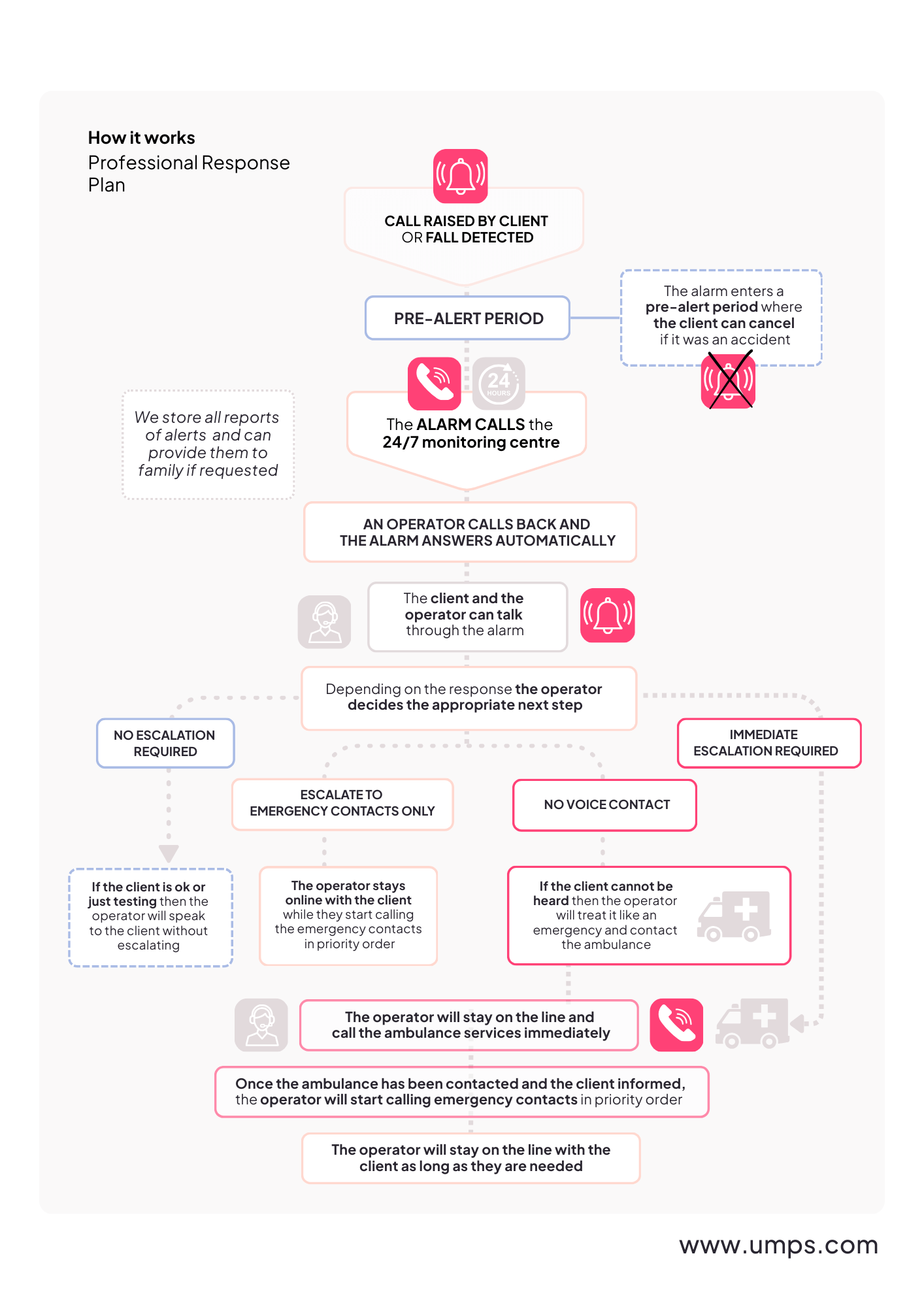
Professional Monitoring for both the Umps Home Alarm and Mobile Alarm
Our Professional Response Plan offers our highest level of care. The operator has the client's profile on file, enabling a personalised response. To provide tailored care we keep a record of:
- Health conditions and allergies — Provides potentially life-saving context to paramedics and identifies if specialised ambulance services are required.
- Access to the home — Instructions for emergency services including key locations, address details, and keysafe codes. Keysafes can be provided and preconfigured.
- Individual client preferences — Specific instructions such as when to call an ambulance, retirement village contacts to notify, or preferred language.
- Emergency contacts — Friends and family to be contacted after the client's safety is confirmed.
The operator stays on the line as long as needed, coordinates emergency services if required, and then contacts nominated family members.
"Referring a monitored alarm for my clients is so important, as it takes the pressure off their family to drop everything in an emergency situation.” — Lisa S., Occupational Therapist
Helping clients pick the right monitoring option
Choosing the right monitoring option depends on your client's circumstances – there's no one-size-fits-all answer. I've put together this comparison to help guide the conversation.
| Family Response Plan | Professional Response Plan |
|---|---|
| More affordable at $10/month. First year included with Mobile Alarm purchase. | Premium option at ~$1.15/day for 24/7 monitoring and support. |
| Best when friends and family are nearby and reliably available. | Best when family may not always be available, or the client doesn't want to 'burden' them. |
| Family are the first to respond. | Trained operator responds first, then coordinates with family and emergency services. |
| Suits clients with relatively straightforward needs. | Suits clients with complex needs who benefit from their health profile being on file. |
| Requires cellular coverage (poor to good signal) with either alarm. | Works with cellular coverage (on either alarm), or via WiFi/Ethernet on the Home Alarm for areas with no cellular.* |
- Connecting calls over WiFi or Ethernet is a relatively new feature of the Home Alarm. Due to how the call pathways work, this only works with the Professional Response Plan. If you have questions about making this work for a client, please reach out: referrals@umps.com
How to answer common client questions
“Can I switch monitoring plans?”
Yes, you can switch anytime by calling Umps (support link). There's no minimum duration, no extra fees, and you can cancel anytime.
“Why do I need to pay for monitoring if my family answers the calls?”
Think of it like a phone plan – the Family Response Plan covers unlimited calls and texts, a SIM card with Telstra connectivity, and phone support during business hours. We support clients for the whole time they use our products, not just at the point of sale.
“Will my family be contacted in an emergency with the Professional Response Plan?”
Yes. Once the operator has confirmed your safety and escalated to emergency services if needed, they'll call your nominated contacts in order of priority.
“How long will the operator speak to me for?”
As long as you need. Even if it takes a long time for the ambulance to arrive, the operator won't hang up.
"I don't have cellular coverage – can I still have monitoring?"
Yes – our Home Alarm with the Professional Response Plan can connect via home WiFi or Ethernet and complete an end-to-end call (not just send the alert). The Family Response Plan requires cellular coverage.
“Will my funding cover monitoring?”
Yes, each platform and scheme is different but funding is usually covered. Talk to our Referral Specialist for help organising this.
“Can I get this through geat2GO?”
Yes, all of our monitoring plans are available on geat2GO. Two months are covered under the scheme.
We're here to help
For questions or support progressing referrals, contact: referrals@umps.com
Umps offers referral kits including:
- Display Mobile Alarms (pendant and wrist-worn options)
- Display Home Alarm buttons and wrist-worn cases
- Brochures to hand out to clients